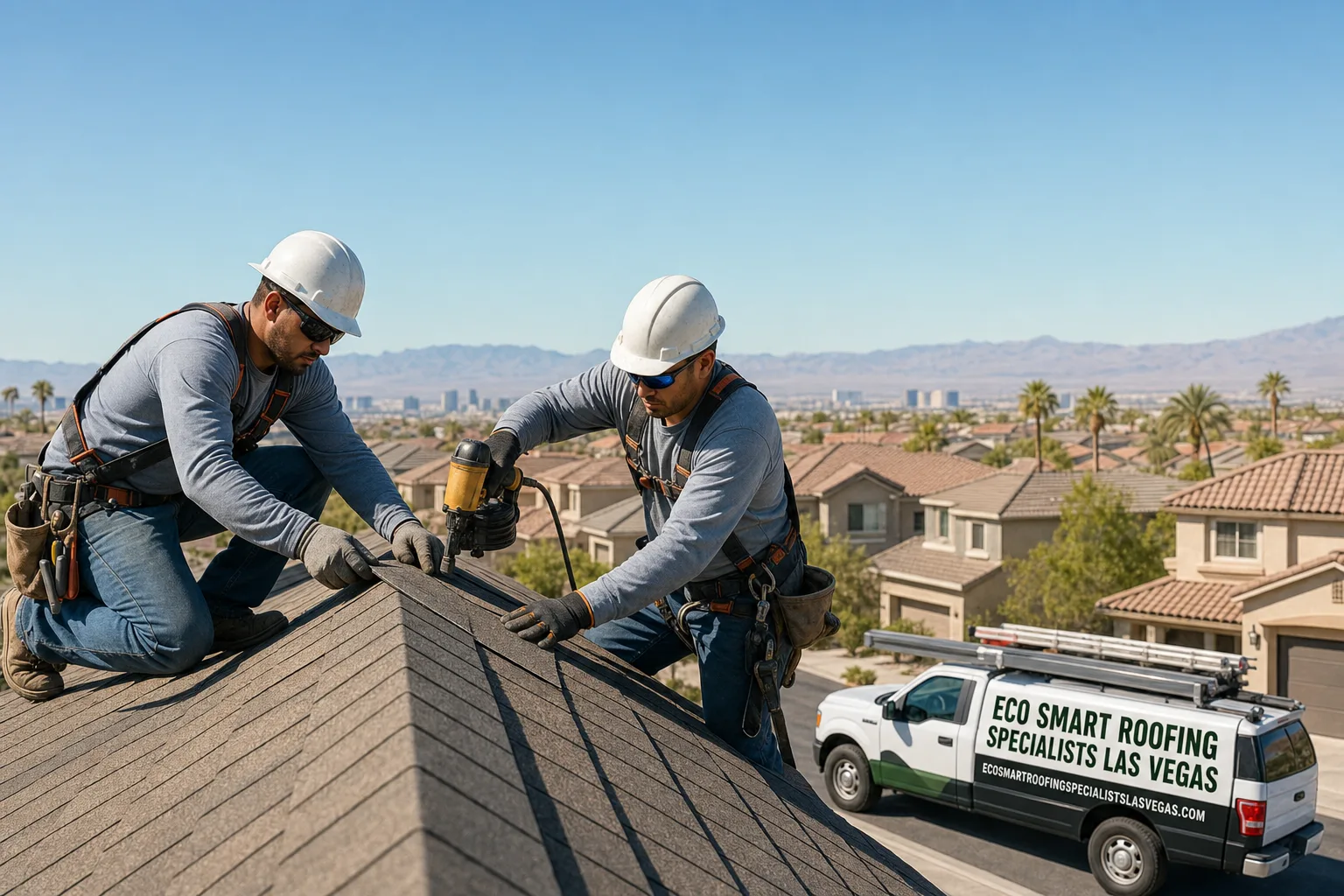
Fast, Reliable Emergency & Storm Damage Across Spring Valley
Emergency storm damage in Spring Valley, NV moves fast — and so do we. Whether a July monsoon cell just breached your flat SPF roof off South Jones Boulevard or wind-driven rain is pushing through a cracked tile ridge on a Spanish Trail home, our crew mobilizes immediately. Harold Graham has been working roofs across the Las Vegas Valley for 35 years, and Spring Valley’s specific inventory of aging flat roofs is territory our team knows on a diagnostic level, not just a map level. Call (725) 800-7344 now — we answer storm calls around the clock.
Why Eco Smart Roofing Specialists Las Vegas Is Spring Valley’s Preferred Emergency & Storm Damage Company
Spring Valley homeowners who’ve called us after a monsoon event tend to call us again — and send their neighbors our way. That’s not an accident. Our Emergency & Storm Damage team has built a track record in this zip code (89103) by treating every flat-roof emergency as the distinct, SPF-specific problem it actually is, not a shingle-roof protocol pasted over a different material system. Harold Graham, our owner and lead technician, is frequently the person on your roof — not a subcontractor hired for the season.
604 homeowners across the Las Vegas Valley have rated us 4.9 stars, and a meaningful share of those reviews come from Spring Valley residents who found us after storm damage caught them off guard. That rating reflects consistency: same-day tarp deployment, honest insurance documentation, and scopes that hold up when the adjuster arrives. We don’t write partial scopes and hope nobody notices the supplement gets denied.
Response time to Spring Valley from our Las Vegas base is fast — we route crews through West Charleston Boulevard and South Jones Boulevard to reach Flamingo Heights, Buffalo Ranch, and Rancho Charleston without delay. When the next monsoon cell is already building on radar and your ceiling is dripping, that geography matters.
Our Emergency & Storm Damage Services in Spring Valley
Emergency Tarp Installation
Emergency tarping in Spring Valley is a fundamentally different job than it is in shingle-heavy suburbs. Most of our flat-roof tarp calls here involve aged tar-and-gravel or SPF systems where you can’t simply nail a tarp down — gravel ballast has to be cleared from the breached field before the polyethylene sheeting can be secured, or the tarp shifts under the next storm’s wind load and leaves the homeowner exposed a second time. Our crews carry the ballast-clearing tools and the weight of professional-grade tarps on every Spring Valley emergency run, because cutting corners at this stage costs everyone more.
After a late-August monsoon cell dropped over an inch of rain in under 30 minutes, we responded to a Flamingo Heights flat roof with active interior water intrusion at two ceiling penetrations. The 1980s SPF substrate had been recoated once — thinly, with a mismatched elastomeric — and then left for roughly 20 years; the topcoat had alligatored across the field and was channeling water straight into the foam cells. We secured heavy-gauge polyethylene tarps over the compromised sections and had the homeowner protected before the next evening’s storm window. That’s the standard we hold every Spring Valley tarp call to.

Storm Damage Repair
Storm damage repair in Spring Valley usually starts with a question the homeowner can’t answer from the ground: how deep has the water actually traveled? On SPF roofs along corridors like West Flamingo Road, a single high-intensity cloudburst can breach an oxidized topcoat and saturate foam cells well beyond the visible entry point — the damage footprint is almost always larger than it looks. Our technicians core-sample suspect areas and document every compromised square foot before we ever discuss repair options, because underdocumenting the scope is how homeowners end up paying out of pocket for damage their insurance should have covered.
For Spring Valley’s Spanish Trail gated community, storm repair often means addressing thermally cracked concrete and clay tile systems where wind-driven monsoon rain has forced water through un-pointed ridge and hip mortar joints. These failures hide beneath the tile surface, and finding them requires a methodical lift-and-inspect approach — not a quick visual pass from a ladder.

Insurance Claims Assistance
Insurance claims for Spring Valley flat-roof storm damage are routinely underdocumented, and the consequence is a denied supplement months after the fact. Adjusters trained on shingle-roof claims frequently underestimate scope when they’re looking at an SPF or built-up system — they note the obvious entry points and miss the lateral foam saturation, the failed base flashing at parapet walls, and the coating separation across the field. We photograph and measure everything, write scopes in the language adjusters and their software recognize, and stay available to walk your carrier’s representative through the damage in person when that’s what it takes.
Spring Valley homeowners in the 89103 zip code carry standard homeowners’ policies that cover sudden storm events, but the line between a covered storm breach and a denied “maintenance failure” claim often comes down to how the damage is documented in the first 48 hours. That window is exactly when we’re on your roof.

Wind Damage
Monsoon season across Spring Valley delivers microburst-force wind gusts that lift ridge caps, separate flashing, and — on clay tile roofs in Spanish Trail — dislodge individual field tiles that then crack the tiles below them when they land. Wind damage on flat SPF roofs is subtler: membrane seams and perimeter edges lift under negative pressure, and what looks like a minor edge separation can allow a week of late-summer storms to drive water laterally under the entire field. We triage wind damage by both the visible failure point and the probable water travel path — not just by what’s obviously broken.

What happens when you call
- 1
A real person answersNo phone trees — you reach a local pro.
- 2
You get an upfront price rangeHonest numbers before anyone is dispatched.
- 3
A background-checked tech heads outLicensed & insured, dispatched right away.
- 4
You approve before work beginsNothing starts until you say go.
Trusted Brands We Service in Spring Valley
When storm damage in Spring Valley requires emergency material replacement — whether that’s a new elastomeric topcoat, flashing components, or a tile section — we carry stock from manufacturers we know and trust. We regularly work with Owens Corning, IKO, and Atlas systems across the Las Vegas Valley, and for Spanish Trail tile repairs we source compatible clay and concrete tile sections that match the existing profiles rather than forcing a visible patch. Seven leading manufacturer lines in our network means we’re not locked into one supplier’s availability — that flexibility matters when a Spring Valley homeowner needs materials on a same-day emergency timeline.
Common Emergency & Storm Damage Problems We See in Spring Valley Homes
- Alligatored SPF topcoats in Flamingo Heights and Rancho Charleston: Deferred elastomeric recoating on 1980s foam roofs — recoated once, badly, and then left for two decades — lets UV-degraded topcoats develop hairline alligatoring that channels monsoon water directly into the foam core. By the time the interior is dripping, the saturated foam footprint is almost always larger than the visible entry point on the surface.
- Blistered tar-and-gravel felt plies along West Flamingo Road: Aging built-up roofs here develop separated felt plies that go completely undetected through the dry spring and early summer, then fail under the first real monsoon event. Tarping effectively requires clearing gravel ballast first — a step that less-experienced crews skip, leaving tarps unsecured and homeowners exposed to the next cell.
- Wind-forced water through un-pointed tile mortar in Spanish Trail: Clay and concrete tile systems in this gated community develop thermally cracked ridge and hip mortar joints after years of extreme Las Vegas thermal cycling. Monsoon wind drives rain through those joints faster than gravity drainage can handle it, and because the failure is concealed beneath tile, adjusters and underprepared roofers routinely underestimate and underdocument the scope.
- Standing water on low-slope roofs after Buffalo Ranch monsoons: Buffalo Ranch’s dense stock of ranch-style construction features low-slope rooflines with minimal drainage pitch — a design that worked adequately for decades of dry Las Vegas spring weather but becomes a pooling problem when a single monsoon cell drops an inch of rain in 20 minutes. Even a sound coating can’t compensate for a blocked or undersized scupper when the water has nowhere to go.
Pricing for Emergency & Storm Damage in Spring Valley, NV
Emergency storm damage work in Spring Valley runs across a real range, and the primary driver is the material system on your roof — not just the size of the breach.
- Emergency tarp installation (flat/SPF roof): $350–$650, depending on field size and whether gravel ballast clearance is required
- Emergency tarp installation (tile roof, Spanish Trail–style): $275–$500
- Storm damage repair — SPF topcoat breach and foam restoration: $800–$2,800 depending on saturation depth and square footage
- Built-up tar-and-gravel felt repair after monsoon breach: $600–$1,800
- Clay/concrete tile wind damage repair (ridge re-pointing, tile replacement): $450–$1,500
- Insurance claim documentation and scope writing: Included with repair assessment — no separate charge
These ranges reflect Spring Valley’s market conditions and the specific material systems common in 89103. A simple tile reset costs less than a foam-core restoration — every quote is specific to what we find on your roof. Estimates are free. Call (725) 800-7344 and we’ll give you a real number, not a range padded to cover our uncertainty.
We Also Serve Cities Near Spring Valley
Our emergency storm damage crews cover Spring Valley and the surrounding communities without any difference in response priority or service standard. Homeowners in Summerlin South deal with comparable monsoon conditions and an increasingly diverse mix of tile and flat rooflines — we bring the same SPF-informed triage approach to every call west of the valley. If your neighbors across the city line need us, we’re there.
Serving Spring Valley, NV — Our Local Coverage Area
We’re based in the Spring Valley area and know this community well. Use the map below to see our service coverage — if you’re nearby, we can almost certainly help.
FAQs — Emergency & Storm Damage in Spring Valley
The first step is clearing gravel ballast from the compromised field before any tarp goes down — skipping that step is the single most common mistake on built-up roof emergency calls in Spring Valley, and it’s why homeowners sometimes find their tarp lifted or shifted by the next storm. Our crew sweeps the ballast away from the breach zone, installs heavy-gauge polyethylene sheeting with perimeter weighting and mechanical edge securement, and confirms the tarp is stable before we leave. A tarp that moves in 40-mph monsoon gusts isn’t protection — it’s a delay. Call (725) 800-7344 and we’ll get a crew out to Flamingo Heights as fast as we can move.
A storm-triggered breach on an aged SPF system in Buffalo Ranch is typically covered as a sudden weather event — your carrier owes you repair of the storm-caused damage regardless of the roof’s age. The fight, in our experience with Spring Valley claims, is over scope: insurers often want to patch the visible entry point, while the actual damaged area (oxidized foam, saturated substrate) extends far beyond it. We document the full extent with photos, moisture readings, and written scope so the claim reflects what actually happened — not just what was easy to photograph from ground level. Bring us in before the adjuster closes the file, not after.
Wind-lifted tiles on a Spanish Trail roof are almost always a storm insurance claim, not a Boral manufacturer warranty issue — the tiles themselves didn’t fail, the weather event exceeded the design load or exposed compromised mortar bedding. Boral’s tile warranties cover manufacturing defects, not wind events. That said, if the mortar joints had previously failed due to Spring Valley’s extreme thermal cycling and that pre-existing gap is what allowed the wind to get purchase under the tile, an adjuster may try to split the claim — we document the condition of the bedding and mortar at time of loss so that determination is based on evidence, not assumption. Call (725) 800-7344 and we’ll walk through the claim process with you.
We can typically reach Rancho Charleston within a few hours of an evening storm call, routing through West Charleston Boulevard — our Spring Valley response time is a priority, not an afterthought. The tarp holds through subsequent monsoon cells when it’s installed correctly: gravel cleared, sheeting weighted and mechanically secured at perimeter edges, lapped properly at any penetrations. A correctly installed tarp on a Rancho Charleston flat roof will hold through repeated monsoon events while the permanent repair is scheduled. Call (725) 800-7344 — don’t wait until the next cell is already on radar.
The first thing we assess is the actual lateral extent of water travel in the foam or felt substrate — not just the visible breach at the surface. On Spring Valley’s aged SPF roofs, the entry point visible from above is almost never the same size as the damaged area below it; oxidized, alligatored foam absorbs and channels water laterally before it ever shows up as a ceiling stain. We core-sample suspect areas and probe with moisture meters across the field before writing a single line of scope, because an insurance document that only covers the surface breach is one the carrier will use to deny your supplement six months later. Documentation first — that’s what protects your claim.
Written by Harold Graham, Owner & Lead Technician at Eco Smart Roofing Specialists Las Vegas, serving Spring Valley, NV since the company’s founding 35 years ago.